
Public speaking coaching,
from the idea to the stage.
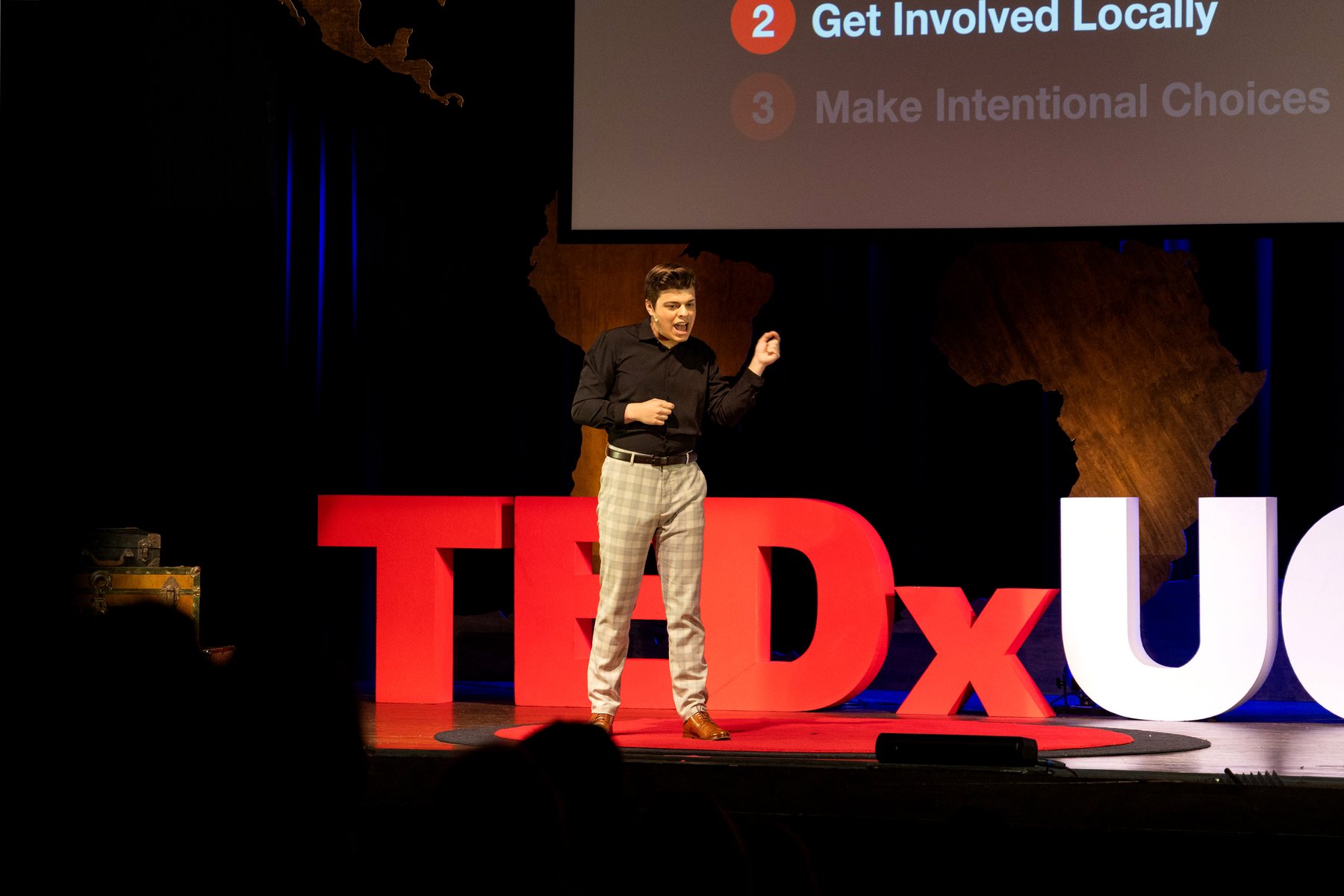
One coach through the whole arc of a talk: the argument, the outline, the draft, the rehearsal on camera, and the debrief afterwards. For a graded speech in COMM 1110, a class presentation in tenth grade, a conference talk, an interview, or the one you have been asked to give and are already dreading. In 2025 I gave a TEDxUGA talk on the Morton Theatre stage, and it went through exactly this.
Nobody is bad at public speaking.
They are under-rehearsed on the wrong thing.
Most people who dread speaking rehearse the words and leave the real problem alone. The real problem is usually one of three: the argument is three ideas pretending to be one, the structure does not survive being said aloud, or the body has never been allowed to practise the fear in a safe room. Each needs a different fix, and a speaker who does not know which one they have works on all three badly.
I find out which one it is first, the same way I start every student in every subject. Then the sessions go there. I have tutored since 2020, I tutor UGA students every week in courses I took, and the TEDx talk is the proof that the method holds under the brightest light a campus has. The talk is on the TEDx channel; the nerves before it are not, but I remember them.
What I coach
The graded speech
COMM 1110 at UGA, or any speech course: the assignment sheet, the rubric, the sentence outline, and the delivery the grader will see once. Four sessions per speech, a semester as two or three cycles.
The cycle →The class presentation
The high-school project that is a quarter of the grade, the senior speech, the capstone defence. Usually the slides are the problem and the student is not.
High-school tutoring →The big talk
A TEDx application and the talk behind it, a conference presentation, a keynote for a student organisation. Longer arc, more drafts, the same cycle run until the talk is yours.
The TEDx talk →The interview and the pitch
Admissions and scholarship interviews, the Honors interview, a pitch to a panel. Short answers that land are built the way a talk is, in a tenth of the time.
Ask about an interview →One talk, four sessions.
1 · The idea and the thesis
Fifty minutes on what the talk is for and who it is for. We pick the argument you can actually make in the time, write the one sentence the talk exists to say, and build the outline from it.
Start with the next talk →2 · The draft, read as the room will hear it
Your full draft, read aloud and read against whatever will judge it: a rubric, a panel, a theatre. We cut what does not serve the thesis, fix the transitions, and make the ending an ending.
Do you write it? →3 · Rehearsal on camera
You deliver it, timed, on Zoom, and we watch it back together. Filler words counted, eye line, where the pauses go, what the hands do. Then again.
How a remote session runs →4 · The debrief
After the talk: what the rubric or the room said, what you felt at minute two, and what changes for the next one. The second cycle starts from here, not from zero.
Ask about a program →Plain facts, for the record.
Who this is for.
The STEM major who took COMM 1110 because the college requires it and would rather do anything else in front of a room. The tenth grader whose presentation grades do not match the work behind them. The senior with a scholarship interview in three weeks. The student officer who has been handed a stage and a microphone and a date.
It is not for someone who wants the speech written, or who needs a drop-in the night before. Both exist; the second is free at the Collaboratory for UGA students, and I will say so.
The talk. On water contamination and the communities that live with it, given at TEDxUGA in March 2025. It went through exactly the cycle above, several times. Watch it on the TEDx channel →
Questions I get
Anything not covered here, ask me directly. (706) 389-0528.
Tell me about your student.
The talk that is coming up, when it is, and what worries you about it. I reply within a day. (706) 389-0528 if a call is easier.